


Growing a lawn from seed is one of the most cost-effective things you can do for your garden. Done right, it produces better, deeper-rooted grass than turf — at a fraction of the price.
This guide covers everything: seed selection, ground prep, sowing, aftercare, and what to do when your lawn is already struggling with patches and moss rather than starting from bare soil.
Quick Answer: What You Need to Know Before You Start
Grass seed germinates in 7–14 days under good conditions (finer fescue species take 14–21 days). The three non-negotiables:
-
Soil temperature consistently above 8–10°C at seed depth
-
Firm seed-to-soil contact — seed sitting on thatch or loose surface won't germinate reliably
-
Consistent moisture — the top 1–2cm must stay damp throughout germination
For a new lawn from bare soil:
-
Clear debris, perennial weeds, and large stones
-
Rotavate or dig to 10–15cm, rake to a fine tilth
-
Firm lightly — footprints should barely show
-
Sow at 35–40g/m², cross-sow in two passes at right angles
-
Rake seed in lightly, firm again, water gently with a rose attachment
-
Keep off the lawn for 6 weeks
For overseeding a patchy or mossy existing lawn:
-
Mow short, scarify to remove moss and thatch, spike compacted areas
-
Apply moss treatment and allow 2–3 weeks before seeding
-
Sow at 20–35g/m² (heavier for thin or bare areas)
-
Rake lightly, firm, keep moist until established
Best timing: March–May or September–mid October. These are the two windows that work in the UK. Everything else is a compromise.
For patchy, thin, or mossy lawns, the GREENER Transformation Kit handles the full sequence — moss treatment, premium grass seed, mycorrhizal pre-seed fertiliser, and liquid seaweed biostimulant, from £89.99.
Why Seed Beats Turf for Most UK Homeowners
Laying turf gives you an instant surface. But for most homeowners, seed wins on every other metric:
-
Cost: Quality lawn seed runs roughly £0.50–£2/m². Turf costs £3–£9/m² before laying. On a 100m² garden, that's a difference of hundreds of pounds
-
Root depth: Grass grown from seed develops roots in situ, adapting to your specific soil. Turf lays pre-grown roots on top of whatever's underneath — they take time to integrate and can fail on poor ground
-
Customisation: You can choose the exact seed mix for your conditions — shade, wear, clay soil, drought — rather than taking whatever blend the turf supplier grows
-
For patchy lawns specifically: Overseeding into existing grass with a quality seed and nutrition system (like the GREENER Transformation Kit) consistently outperforms replacing patches with turf, and the grass integrates seamlessly with what's already there
Choosing the Right Grass Seed for Your Lawn
UK lawns use cool-season grasses — they peak in spring and autumn, tolerate British winters, and cope with the mild, variable summers we actually get. Warm-season varieties (Bermuda, Zoysia, Buffalo) require sustained summer temperatures of 29–35°C and are not suitable for UK conditions.
The three main families:
Perennial Ryegrass (Lolium perenne)
Best for: Family lawns, patchy lawns needing fast recovery, high-traffic areas
The workhorse of UK lawn renovation. Germinates in 5–10 days, establishes quickly, handles foot traffic well. Modern cultivars have significantly improved disease resistance and leaf texture compared to older commodity varieties. If you have a patchy lawn and want visible results within 6–8 weeks, ryegrass-dominant mixes are the fastest route.
Fine Fescue (Festuca species)
Best for: Shaded lawns, low-maintenance gardens, dry or sandy soils
Slower to germinate (14–21 days) and establish, but lower water and fertiliser requirements once settled. Fine fescues — chewing, red, and hard fescue — are the most shade-tolerant UK lawn grasses. Not suited to heavy foot traffic; they recover slowly from damage.
Tall Fescue (Festuca arundinacea)
Best for: Heavy-use areas, clay soils, genuinely hard-wearing lawns
Develops a deep root system that gives real drought tolerance once established. Coarser texture than ryegrass or fine fescue — less refined appearance but significantly more durable under sustained use.
For most UK renovation projects — patchy, thin, or mossy lawns — a ryegrass/fescue blend is the right call. It gives you fast establishment where the lawn is bare, good wear tolerance, and decent colour.
The GREENER Transformation Kit uses PM 51 Greenscape (DLF Seeds Ltd), a professional-grade ryegrass/fescue blend selected for UK conditions, fast establishment, and disease resistance. See the full kit →
Ground Preparation: Why This Is 80% of the Job
Poor ground prep is the most common reason grass seed fails. Seed sown onto compacted soil, heavy thatch, or a mossy surface won't make proper contact with the earth — germination will be patchy and establishment weak regardless of seed quality.
For a new lawn from bare soil
-
Clear the ground — remove old turf, perennial weeds (dig out roots, don't just cut them), debris, and stones larger than 2cm
-
Improve poor soil — if the existing earth is heavily compacted, clay-heavy, or poor quality, add 2–5cm of good topsoil before working
-
Dig or rotavate to 10–15cm depth. Break up large clods
-
Rake level — work the surface to a fine tilth. Any significant bumps or hollows will cause uneven mowing later
-
Firm — walk across the area in small shuffling steps, or use a light roller. The surface should feel firm; footprints should barely show
-
Check drainage — water a test area and confirm standing water disappears within a few hours. Address drainage issues before sowing
-
Apply pre-seed fertiliser — 3–7 days before sowing. Standard lawn feeds are nitrogen-heavy, which promotes leafy growth but doesn't support root establishment. Use a pre-seed formula with phosphorus and mycorrhizal support
For overseeding an existing lawn
-
Mow short — cut down to around 25mm
-
Scarify — rake or machine-scarify vigorously to remove moss, dead thatch, and debris. This is the step most people skip and then wonder why overseeding fails
-
Spike — fork compacted areas to 7–10cm depth to improve drainage and aeration
-
Treat moss first — if your lawn has significant moss, treat it before overseeding. Seeding into active moss is a waste of seed. The POWER moss treatment in the GREENER Transformation Kit is applied 2–3 weeks before seeding for this reason — the dead moss is then raked out before seed goes down
👉 The GREENER Transformation Kit handles the full prep-to-seed sequence →
How to Sow Grass Seed
New lawn
-
Measure and weigh your seed. For a new lawn: 35–40g/m². Divide into two equal lots
-
Cross-sow — broadcast the first half walking in one direction, the second half at right angles. This prevents striping and catches any gaps from the first pass
-
Rake in lightly — work seed into the top 5–10mm of soil. Don't bury it deeper
-
Firm — walk over the sown area or use a light roller to improve seed-to-soil contact. This is the most skipped step and one of the most important
-
Water immediately using a fine rose or sprinkler. Never use a hose directly — it washes seed into clumps
Overseeding
-
Rate: 20–25g/m² for a light refresh; 30–35g/m² for thin or bare areas
-
Scatter evenly over the prepared surface
-
Rake lightly — the goal is to get seed falling through existing grass to make soil contact, not to bury it
-
Firm by treading
-
Water gently and keep moist
The Part Most Guides Don't Cover: Nutrition at Seeding Stage
Sowing seed and watering it is not enough for reliable establishment on a struggling lawn.
What establishing grass needs at seeding stage:
-
Phosphorus for root development — most standard lawn feeds are nitrogen-dominant and inappropriate at this stage
-
Mycorrhizal inoculant — fungal networks that colonise root systems from germination, extending the effective root zone and improving nutrient uptake. This has the biggest single impact on how quickly new grass establishes
The GROWTH pre-seed fertiliser in the GREENER Transformation Kit includes both — applied at seeding alongside the PM 51 Greenscape seed. The mycorrhizal inoculant is formulated to colonise from day one of germination, not after the plant is established. This is the difference in the kit that most people don't anticipate and that shows up most clearly in how evenly and quickly the new grass fills in.
After establishment, the BOOST liquid seaweed biostimulant supports root development and drought tolerance during the vulnerable early weeks.
When to Sow: Timing Your Renovation Window
|
Window |
Conditions |
Verdict |
|---|---|---|
|
Spring (March–May) |
Soil warming, natural rainfall, full season ahead |
✅ Good |
|
Summer (June–August) |
Drought stress risk during establishment |
⚠️ Avoid unless you can water daily |
|
Autumn (Sept–Oct) |
Warm soil, reliable moisture, low weed competition |
✅ Best |
|
Winter (Nov–Feb) |
Soil below 8°C, germination won't happen |
❌ Don't |
Autumn is the better window if you have a choice. Soil is warm from summer, weed competition is lower, and reliable autumn rain removes the watering burden. Autumn-seeded lawns consistently look better the following spring than equivalent spring-seeded lawns.
What to Expect: A Realistic Timeline
Most first-time overseeders expect too much too soon and panic when the lawn looks worse at week two than it did before they started. This is normal.
Mossy lawns with POWER applied: The moss darkens and dies after application. The lawn looks worse for 2–3 weeks. This is the treatment working. Rake out the dead moss before seeding.
Post-seeding:
-
1–2 weeks: Bare soil or raked surface, no visible change
-
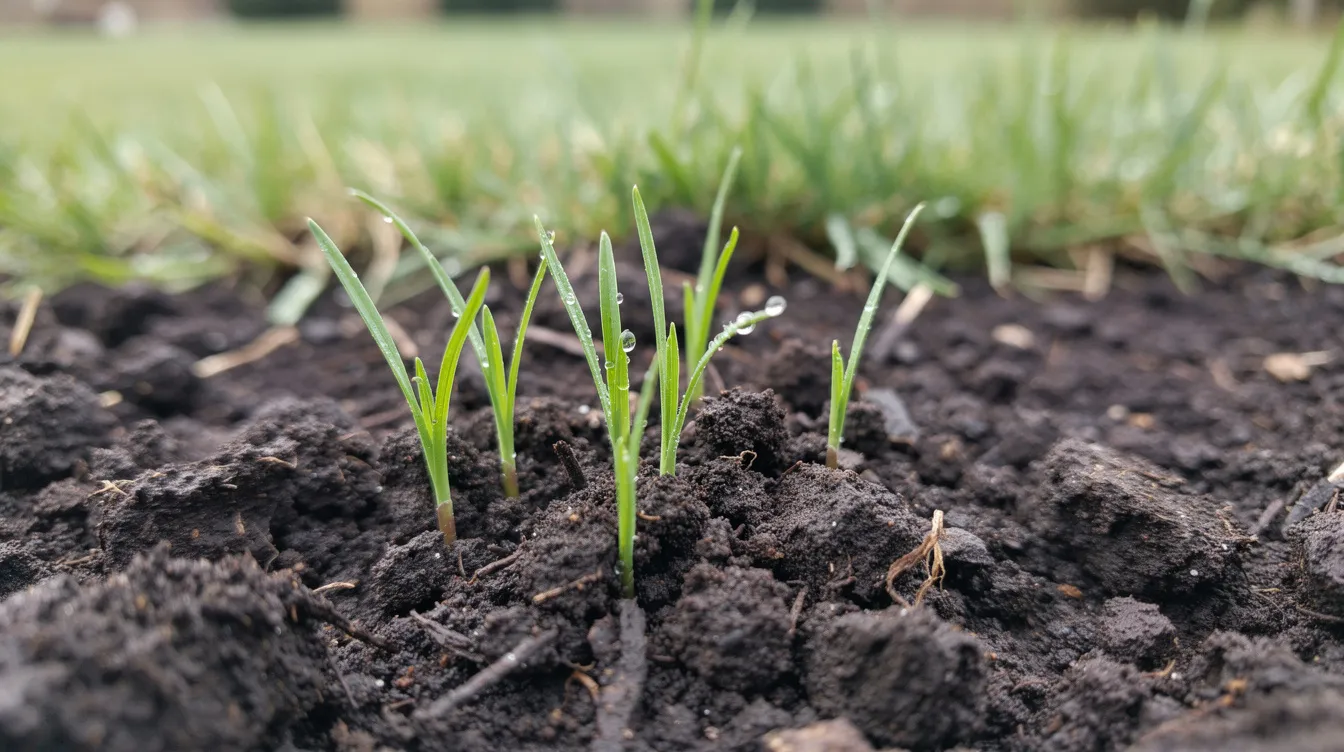
7–14 days: First shoots visible in ideal conditions (ryegrass faster, fescues slower)
-
3–4 weeks: New grass visible across most areas
-
6–8 weeks: Noticeable thickening, patches filling, improved colour
-
10–12 weeks: Ready for normal mowing routine, strong enough for light use
Keep off the lawn for the first 6 weeks. Mow for the first time when grass reaches 7–8cm — cut back to 5cm using sharp blades, removing no more than one-third of the height.
Common Mistakes That Kill Grass Seed
Wrong timing — sowing in cold late winter or dry midsummer. The two windows exist for a reason.
Skipping scarification — the most common overseeding mistake. Seed scattered onto thatch, moss, or dense existing grass without scarifying first rarely makes soil contact and fails to germinate properly.
Treating moss and seeding at the same time — moss treatment needs 2–3 weeks to work before you seed. Seeding straight after or alongside moss killer doesn't give the dead moss time to be removed.
Inconsistent watering — heavy watering washes seed; letting the seedbed dry completely kills emerging seedlings. Light and frequent is correct for the first 2–3 weeks.
Mowing too soon or too low — wait until grass reaches 7–8cm. Cutting earlier, or cutting lower than 5cm on a new lawn, stresses fragile root systems.
Using the wrong fertiliser — applying a standard high-nitrogen lawn feed at seeding stage promotes leafy growth at the expense of roots. Use a pre-seed formula with phosphorus and mycorrhizal support.
Aftercare: The First 12 Weeks
The first 12 weeks are when new grass is most vulnerable — and also when the right care makes the biggest long-term difference.
-
Weeks 1–3: Water little and often. Top 1–2cm stays consistently damp
-
Weeks 3–6: Gradually reduce watering frequency, increase depth per session. Encouraging roots to go deeper
-
First mow: At 7–8cm, cut to 5cm. Never remove more than one-third of height in a single cut
-
Weeks 6–8: Once mown twice, apply BOOST liquid seaweed biostimulant to support continued root development and early drought tolerance
-
Week 10–12: Lawn ready for normal routine — regular mowing, standard feeding programme, light foot traffic
Summary
Grow grass from seed correctly and you'll have a better lawn than turf at a fraction of the cost. The three things that actually determine success:
-
Timing — spring or autumn only
-
Ground prep — especially scarification and moss treatment before overseeding
-
The right system — seed + pre-seed nutrition + root support at the right stages, not just seed on its own
For patchy, mossy, or thin UK lawns, the GREENER Transformation Kit is the complete sequence in one box: POWER moss treatment, PM 51 Greenscape seed, GROWTH pre-seed fertiliser with mycorrhizal inoculant, and BOOST liquid seaweed biostimulant.
From £89.99. 28-Day Lawn Pledge included.
👉 Get the GREENER Transformation Kit →
Questions about your lawn or which kit size to order? Get in touch →


