


Most lawn problems in UK gardens have a specific cause with a specific fix. If you’re asking what’s wrong with my lawn in the UK, the usual culprits are moss, thatch, soil compaction, drought dormancy, fungal disease, or shade but patchy grass, thinning, and weak growth can look very similar on the surface. Applying the wrong treatment wastes time and money and can make the lawn worse.
For UK homeowners and gardeners who want to diagnose the problem properly before spending more on seed, feed, or weedkiller, this guide breaks down the six most common lawn problems, how to tell which one you actually have, and the treatment sequence that fits each one.
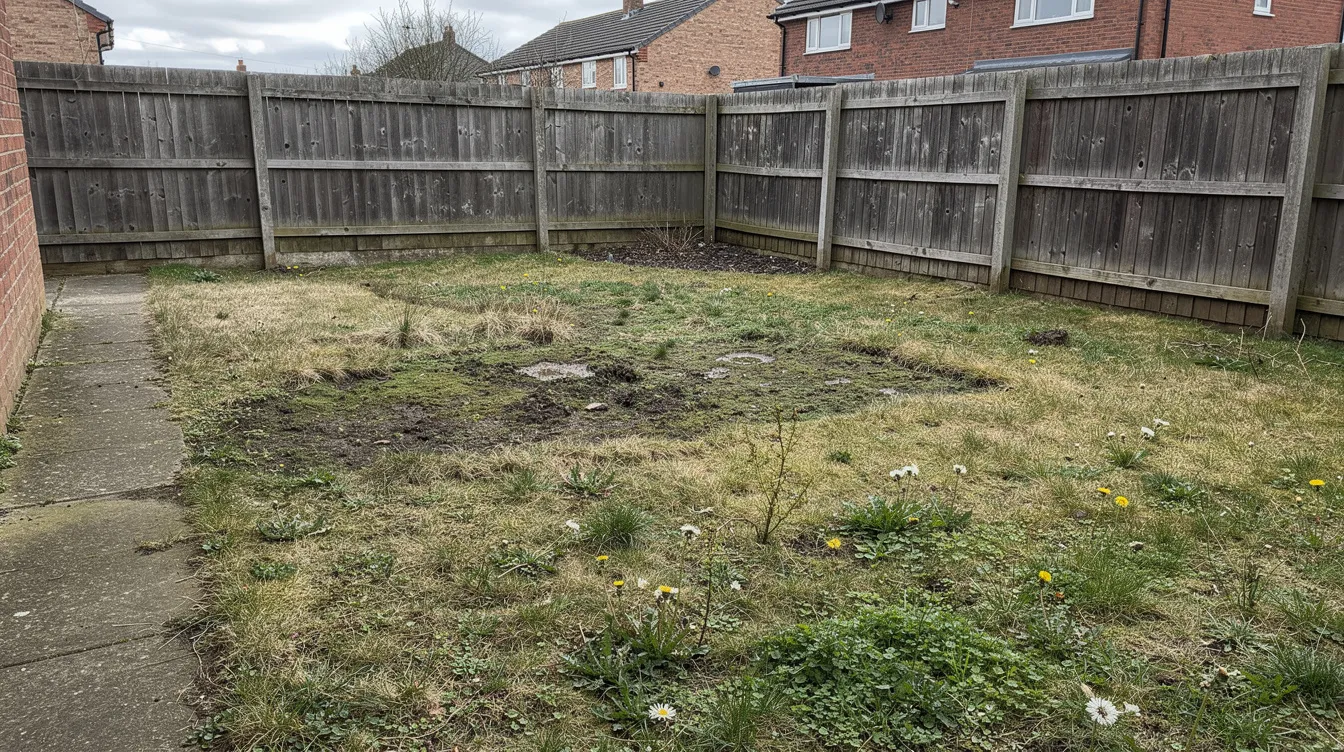
How to Use This Guide
Walk your lawn before reading further. Look at where the problems are concentrated, what the surface feels like underfoot, and what the grass itself looks like up close. The location and pattern of damage is usually the most useful diagnostic information.
Problems that follow shade lines suggest a shade issue. Problems concentrated in high-traffic areas suggest compaction. Uniform yellowing across the full lawn in summer suggests drought dormancy. Irregular brown patches with a soft, spongy feel suggest moss or thatch. Specific shapes such as circles or rings suggest fungal disease.
With that in mind, work through the six causes below and identify the one that best fits what you are seeing.
Cause 1: Moss
How to identify it
Moss is the most common underlying cause of poor UK lawns and is frequently underdiagnosed because it is not always obviously visible.
Press your hand flat onto the lawn surface. If it feels spongy rather than firm, you have a significant moss layer beneath the visible grass. If you pull back a handful of the surface material and find a dense green or brown mat with minimal soil contact, that is moss.
Moss is almost always present to some degree in UK lawns. The climate, shade, and soil conditions that characterise the typical UK garden are ideal for moss. You do not need to see an obviously green moss covering to have a moss problem significant enough to affect lawn recovery.
According to the Royal Horticultural Society, moss in lawns is primarily caused by poor drainage, shade, soil compaction, and low fertility rather than by a simple lack of lawn care products. Treating moss without addressing these underlying conditions may require repeated treatment.
Why it matters
Moss is not just an aesthetic problem. It prevents grass seed from making soil contact, which is why lawns with significant moss fail to respond to reseeding. Seed scattered onto a moss layer germinates briefly using its own energy reserves, then dies because roots cannot reach soil. This is the cause of the "seed but nothing happens" experience that most UK homeowners have had at least once.
The fix
Apply a moss killer to the full lawn area in week one. Leave it for 7 to 14 days until the moss has blackened and died back. Then scarify to remove the dead moss and debris, exposing bare soil for seeding.
Treat moss before doing anything else. No other lawn intervention will work properly until the moss is cleared.
For a full guide to the complete renovation sequence after moss treatment, see our how to fix a patchy lawn guide.
Cause 2: Thatch
How to identify it
Thatch is the layer of dead organic material that accumulates between the grass blades and the soil surface over time. A small amount of thatch (under 1cm) is normal and beneficial. Anything thicker restricts water, air, and nutrients from reaching grass roots.
Cut a small cross-section of turf with a spade and look at the profile. A brown spongy layer between the green grass blades and the visible soil is thatch. Measure it. Over 1cm is problematic. Over 2cm is significant.
Thatchy lawns typically feel bouncy underfoot, dry out quickly even in wet weather, and have a yellow-green colour rather than a deep green. The grass may look reasonably even from a distance but up close appears thin and struggles to respond to feeding.
Why it matters
Thatch acts as a physical barrier. Water and fertiliser applied to a thatchy lawn sit in the thatch layer rather than penetrating to the roots. The grass is effectively being starved and parched despite apparent effort. This is a common reason that lawns do not respond to feeding and watering.
The fix
Scarification. Run a scarifier across the lawn in two directions to remove the thatch layer and expose the soil beneath. For severely thatchy lawns this may take two passes.
Scarification is best done in late August to September before autumn reseeding, or in spring once the ground has dried out enough to avoid compaction from the machine.
After scarification, overseed and fertilise with a mycorrhizal fertiliser to support establishment of new grass in the cleared surface.
Cause 3: Compaction
How to identify it
Compacted soil restricts root growth and drainage. It is most common in high-traffic areas: pathways, play areas, edges near gates, and any area where vehicles have occasionally crossed.
Test for compaction by pushing a garden fork into the lawn with moderate pressure. In healthy soil it should penetrate to 15cm without significant resistance. If it resists above 10cm, the soil is compacted.
Compacted areas typically show thin, struggling grass that does not respond well to feeding and takes longer to green up in spring. Water sits on the surface rather than draining quickly after rain.
Why it matters
Grass roots cannot penetrate significantly compacted soil. The root systems in compacted areas are shallow, making the grass drought-vulnerable and unable to access nutrients and moisture at depth. No amount of surface treatment will overcome severe compaction without addressing the underlying soil structure.
The fix
Aeration. For moderate compaction on smaller lawns, push a garden fork in to 15cm depth and lever gently across the affected area. For larger lawns or severe compaction, a hollow-tine aerator removes cores of soil, opening channels for air, water, and roots.
After aeration, topdress with a sandy topsoil or lawn dressing to fill the channels and improve drainage. Then overseed and fertilise to establish new grass in the improved soil conditions.
Aeration is best carried out in autumn before reseeding, when the soil is moist enough to work but not waterlogged.
Cause 4: Drought Dormancy
How to identify it
Drought dormancy is the correct diagnosis for a lawn that turns yellow or brown uniformly across the full surface during or after a dry, warm period. It is consistently misdiagnosed as lawn death, which leads to unnecessary intervention.
Drought dormancy is a survival mechanism. When water becomes scarce, grass diverts energy from top growth to root preservation. The blades yellow or brown. The roots remain alive. The lawn recovers when rain returns.
Test for dormancy versus death by pulling gently on the yellowed grass. If there is resistance at the roots, the plant is alive and dormant. If the grass pulls away freely with no resistance, those areas may be genuinely dead.
Uniform yellowing following a dry period is dormancy. Irregular patches that appeared during normal conditions are something else: disease, compaction, or chemical damage.
Why it matters
The instinct when a lawn goes yellow is to intervene: apply fertiliser, overseed, or buy a product. Intervening during drought dormancy with fertiliser stimulates water-hungry growth that the plant cannot support, worsening the stress. Overseeding during dormancy wastes seed that will not germinate without moisture.
For more detail on summer lawn yellowing specifically, see our yellow lawn summer guide.
The fix
For dormancy: do nothing except water once or twice a week if practical. The lawn will recover when autumn rain returns.
For areas that are genuinely dead after prolonged drought: wait until the autumn renovation window (late August to October) and overseed those areas following the standard renovation sequence.
Cause 5: Common Lawn Diseases (Fungal Disease)
How to identify it
Fungal diseases are among the most common lawn diseases in the UK, and around 70% of lawn problems are caused by fungal infections. Unlike the uniform yellowing of drought or the irregular patchiness of moss and thatch, these lawn diseases create specific shapes.
Fusarium patch produces circular patches of yellow-brown grass, 3 to 30cm across, often with a white or pink cottony margin in humid conditions. Most common in autumn and winter, with outbreaks also especially common in early spring when conditions stay damp, though it can appear in warm, humid summer periods.
Red thread produces reddish-pink thread-like strands visible on the grass blades and can appear as circular patches of red-brown grass. Very common in UK lawns, particularly on under-fed grass in summer, and high humidity encourages it.
Leaf Spot is one of the common diseases that affects lawns, and warm, humid conditions favour leaf spot development.
Dollar Spot is a fungus that causes small, circular yellow spots on grass and is more likely where heavy dews persist and fertility is low.
Rhizoctonia causes brown patches that can enlarge significantly.
Fairy rings produce circles or arcs of darker green, lush grass, sometimes with a ring of dead or mushroom-producing grass inside or outside the darker ring.
According to the British Mycological Society, most turf fungal infections in the UK are associated with specific combinations of temperature, moisture, and soil conditions rather than with lawn care neglect.
Why it matters
Fungal disease can spread quickly if left untreated. Most lawn diseases are fungal in origin, with around 70% caused by fungal infections, and fusarium patch in particular can expand rapidly in humid conditions. Identification matters because the fix is different from other lawn problems: fungicide rather than renovation.
The fix
For red thread: apply a balanced lawn fertiliser. Red thread is most common on under-fed lawns and often resolves with improved nutrition, which also encourages healthy new growth even after the visible red threads fade. A renovation fertiliser containing mycorrhizal fungi supports recovery.
For fusarium: apply a lawn fungicide following product instructions. Remove infected clippings during mowing to reduce spread, and do not mow when the grass is wet or risk over watering, as both prolong leaf moisture and encourage fungal growth.
For fairy rings: the rings themselves are very difficult to eliminate. The usual approach is to treat the appearance rather than the cause: aerate heavily across the ring, water thoroughly, and apply a nitrogen fertiliser to mask the colour difference. Complete elimination requires removing and replacing the affected soil. Poorly drained lawns with poor air circulation are more prone to problems, so aeration and better air movement help reduce risk.
Cause 6: Shade
How to identify it
Shade damage is straightforward to diagnose: the problem areas correspond to the shadow cast by trees, walls, fences, or buildings across different times of day.
Grass requires a minimum of 4 to 5 hours of direct sunlight daily to photosynthesise and grow at a density sufficient to resist moss and weeds. Areas receiving less than this threshold will persistently thin and struggle regardless of how well the rest of the lawn is maintained.
Shade problems tend to worsen gradually as trees mature and their canopy expands. A lawn that was fine five years ago may now have significant shade issues as neighbouring trees have grown.
Why it matters
Shade is a constraint, not a failure of maintenance. No amount of feeding, renovation product, or professional treatment will produce dense, thick grass in an area that does not receive enough light. Understanding this prevents repeated failed attempts to renovate areas that will always struggle.
The fix
Shade-tolerant grass seed mixes (typically fescue-heavy) perform better in low-light conditions than standard ryegrass blends. They will not produce the same density as a well-lit lawn but are significantly better than ryegrass in shade.
Reducing the shade source where possible, such as raising tree canopy height by removing lower branches, can meaningfully improve conditions. In very deep shade, ground cover plants rather than grass may be the practical long-term solution.
When overseeding shaded areas, use a shade-specific mix and apply at a slightly higher rate than the standard recommendation to compensate for the lower germination rate in reduced light.
The Most Common Pattern: Multiple Causes Together
Most UK lawns with significant problems do not have a single cause. The typical pattern is: moss establishing in a lawn weakened by thatch and moderate compaction, with shade contributing in specific areas. Drought dormancy then masks the extent of the underlying problem in summer when homeowners begin to notice the lawn looks poor, even though a healthy lawn year round also depends on steady basics such as regular mowing, since frequent mowing helps maintain turf density and suppress weeds.
Addressing only one cause while ignoring the others produces incomplete results. A full renovation sequence handles the most common combination: moss treatment first, followed by scarification to remove thatch, aeration for compacted areas, and then simultaneous seeding, fertilising, and biostimulant application.
For a complete step-by-step guide to the full renovation sequence, read our complete lawn renovation guide and our beginner lawn renovation guide.
Fix the Root Cause for a Healthy Lawn, Not Just the Symptom
The GREENER Transformation Kit is built around the correct sequence for addressing the most common combination of UK lawn problems: moss first, then simultaneous seeding with mycorrhizal fertiliser and seaweed biostimulant on day one of growth.
Applied in under an hour. Results visible in 4 weeks. Backed by a 60-Day Money Back Guarantee.
Available for lawns from 100m² to 500m².
Frequently Asked Questions
Why is my lawn patchy?
Patchy grass in UK lawns is most commonly caused by moss preventing seed-to-soil contact, excessive thatch restricting water and nutrient penetration, or compaction limiting root growth. In many cases all three are present simultaneously. The correct fix is moss treatment first, then scarification to remove thatch, aeration for compacted areas, and then reseeding with a mycorrhizal fertiliser and biostimulant.
Why does my lawn have brown patches?
Uniform yellowing across the full lawn during or after a dry period is almost always drought dormancy, not lawn death. The grass is usually still alive, and a healthy lawn will recover when rain returns. Do not apply fertiliser or overseed during dormancy. Irregular discoloured patches that appeared during normal conditions may indicate fungal disease, chemical damage, or dog urine.
Why is my lawn not growing?
Lawns stop growing or grow very slowly for several reasons: temperatures below 5 to 6 degrees Celsius in winter, drought dormancy in summer, severe compaction, or disease. If growth is poor during the active growing season (April to October) in normal moisture conditions, investigate thatch and compaction as the most likely causes.
Why does my lawn have bare patches?
Bare patches in an otherwise growing lawn typically indicate localised moss, dog urine damage, heavy foot traffic compaction, or chemical scorch from over-applied fertiliser. Treat the specific cause for each patch before reseeding. Seeding bare patches without addressing the cause produces temporary results that regress within a season.
Why is my lawn full of weeds?
Weeds establish most readily in thin grass where the turf canopy is not dense enough to outcompete them. The solution is improving the grass density rather than repeated weedkilling. Dense, well-fed grass suppresses most weeds naturally. Apply selective weedkiller for existing weeds, then renovate to thicken the turf and prevent recolonisation.
Why does my lawn keep failing even when I treat it?
The most common reason for repeated treatment failure is applying the wrong fix for the underlying cause, or applying the right products in the wrong order. Seeding before treating moss, fertilising without bio-stimulant support at germination, and using annual rather than perennial grass seed are the three most common sequencing failures. A complete renovation kit with built-in sequencing guidance addresses all three.


