


You've bought the grass seed. You've scattered it across your patchy, bare lawn. You've watered it in and waited.
And nothing happened.
Or worse, a few blades came through, then died back within weeks.
If that sounds familiar, you're not alone. Reseeding a lawn is one of the most commonly attempted DIY lawn tasks in the UK, and one of the most commonly failed. Not because people don't try hard enough but because they follow the wrong sequence.
This guide covers how to reseed a lawn in the UK properly. The right prep, the right timing, and the step that most people skip entirely — which is almost always the reason the seed never takes.
Why Most Reseeding Attempts Fail on Bare Patches
Before we get into the how, it's worth understanding why reseeding so often doesn't work.
The most common reason is this: grass seed cannot establish successfully in a lawn that still has moss or dead organic matter present.
Moss competes directly with new seedlings for light, moisture, and space. If you scatter seed over a mossy lawn, the seed lands on top of the moss layer — not in contact with the soil — and either fails to germinate or dies in the first few weeks.
The second most common reason is timing. Grass seed needs soil temperatures above 8–10°C to germinate. Sow too early in spring or too late in autumn and the seed sits dormant, vulnerable to birds, weather, and disease before it ever gets a chance.
The third reason is fertiliser. Most people either skip feeding entirely or apply a general-purpose fertiliser that isn't formulated to support germination. New seedlings need specific nutrients — particularly phosphorus for root development — at the right time.
Get the sequence wrong and you'll be back to square one in six weeks.
When to Reseed a Lawn in the UK
Timing matters more than almost anything else.
The two best windows for reseeding in the UK are the best time to overseed, and the right time to overseed depends on steady moisture and soil temperatures between 10°C and 18°C:
Early autumn (late summer to late September) — this is the best time of year to reseed in the UK. Soil temperatures are still warm from summer, the ground retains moisture more consistently, and there's less competition from weeds. New grass has time to establish before the first frosts, and by spring your lawn is already thick and rooted.
Mid to late spring (March to early May) — the second window, with early May marking the upper end of the prime spring period. Soil is warming up, daylight hours are increasing, and conditions favour germination. Be aware that spring-sown lawns face more competition from weeds and require more consistent watering than autumn-sown grass.
Avoid:
-
Reseeding in late June and July, when heat and drying conditions can stop newly sown seeds from establishing
-
Reseeding during frost or cold snaps (seed won't germinate below 8°C)
-
Reseeding during prolonged wet periods (seed washes, soil compacts)
If you're reading this outside those windows, plan ahead rather than rush it. A well-timed reseed in October will always outperform a rushed job in July.
What You Need Before You Start
Tools
-
Scarifier or stiff rake (manual or electric)
-
Garden fork or aerator (to create holes in the soil for better air circulation before reseeding)
-
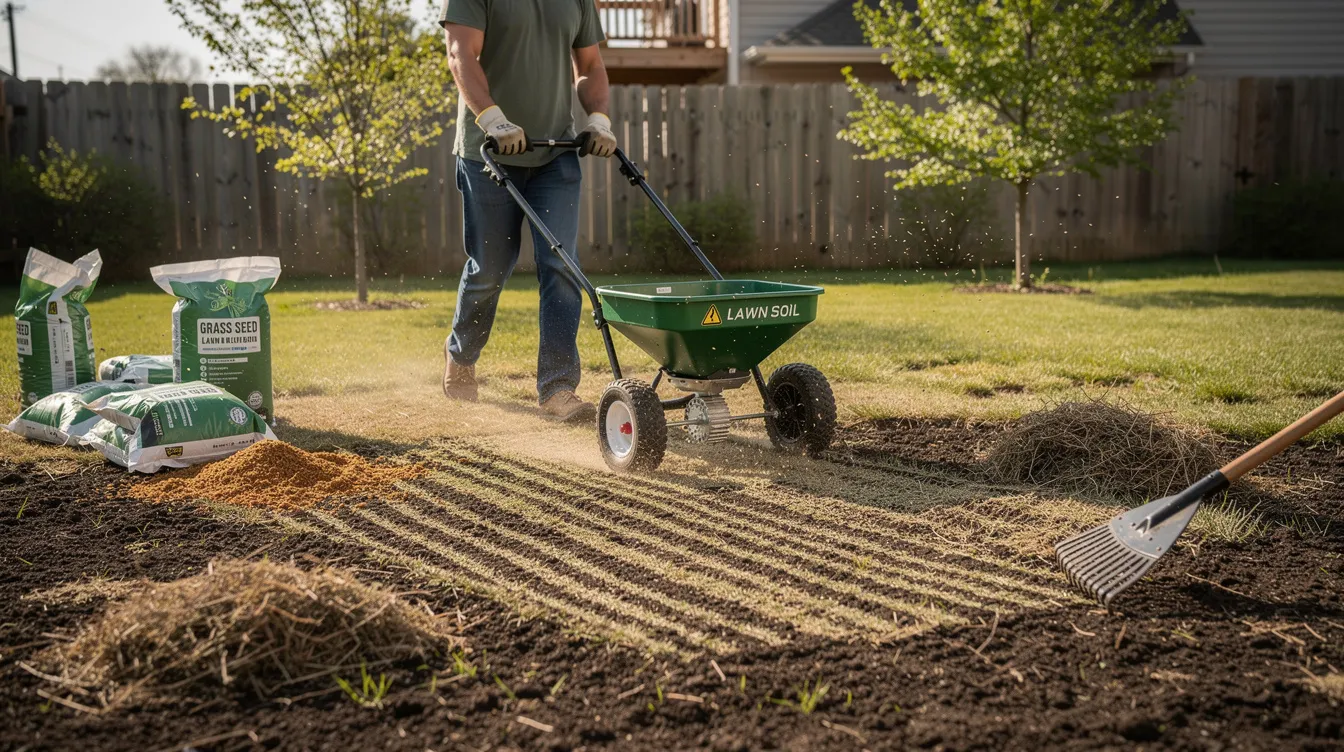
Lawn spreader (for even seed and fertiliser distribution)
-
Watering can or garden hose with a fine spray setting; if needed, a mower for light mowing as part of prep before seeding
Products and Why the Sequence Matters
This is where most guides stop short. They list products without telling you the order — and the order is everything. Mow the existing lawn before sowing to reduce competition for light and moisture.
Step 1: A moss killer and lawn treatment product: Applied first, before any seeding. This is non-negotiable. If your lawn has moss (and most UK lawns do), this must be addressed before you introduce seed. Skipping this step is the single biggest reason reseeding fails.
Step 2: Grass seed suitable for UK conditions: Applied after the moss has been cleared and the lawn has been scarified. UK lawns need cultivars bred for our climate — cool, wet, and often shaded. Cheap seed mixes often contain annual rye varieties that germinate quickly but don't persist. Choose a lawn seed mix based on perennial ryegrass or fescue.
Step 3: A granular lawn fertiliser with mycorrhizal support: Applied at the same time as the seed — not before, not after. The mycorrhizal fungi in a quality fertiliser, used here as a lawn feed, actively support root development and the germination process from day one. This is the step that separates a good reseed from a great one.
Step 4: A liquid seaweed bio-stimulant: Applied on the same day as seeding and fertilising. Seaweed extract promotes cell division, root growth, and stress resistance in new seedlings. It's the accelerant.
How to Reseed a Lawn: Step-by-Step
Step 1: Kill the Moss First
Apply your moss killer and lawn treatment product evenly across the whole lawn area, not just the obvious mossy spots. If broadleaf weeds are present, remove weeds before reseeding. Any weed killer should be used well before seeding and strictly to the label timings so it does not affect new grass. Follow the product instructions for dwell time — typically 1–2 weeks.
You'll notice the moss blackening and dying back. This is exactly what you want. Do not be tempted to skip this step because the moss "doesn't look that bad." Even light moss coverage will prevent seed from making contact with the soil.
Do not scarify or seed until the moss treatment period is complete.
Step 2: Scarify and Clear
Once the moss is dead, it's time to scarify in preparation for reseeding. This means removing dead organic matter to remove thatch and debris from the surface of the lawn to expose bare soil beneath.
Use a scarifier (electric or manual) set to a depth that scratches the soil surface. Run it across the lawn in two directions — horizontal and vertical — for thorough coverage.
Rake up and remove all the debris. Overseeding into this cleaned surface improves lawn density and resilience as the grass thickens back up. A healthy lawn is better able to crowd out unwanted weeds and can reduce reliance on chemical treatments over time. Your lawn will look considerably worse at this point. This is normal. What you're looking at is bare, workable soil — exactly what grass seed needs to germinate.
If the soil is particularly compacted, fork it lightly or aerate before seeding. This improves drainage, creates holes in the soil for better air circulation, and gives new roots room to develop.
Step 3: Level and Prepare the Surface
Check for any dips, humps, or uneven patches. Fill low areas with a fine-grade topsoil or lawn dressing, with sand where drainage needs improving, and rake level. Spread top dressing in a thin layer at roughly 2–4 kg per m² on a dry day so it stays even and workable. Firm lightly with the back of a rake — you're not compacting, just ensuring the seed will have good contact with the soil, and this light covering helps seeds germinate without burying the existing grass.
Remove any stones, debris, or large clumps.
Step 4: Apply Seed and Fertiliser Together
This is the step most guides get wrong.
Grass seed and a germination-supporting fertiliser should be applied simultaneously — on the same day. The mycorrhizal fungi in a quality granular fertiliser begin working as soon as they're in contact with the soil, which means they're available to seedling roots from the moment germination begins, and the lawn feed supports early establishment as the lawn seed starts to germinate.
Apply seed at the recommended rate for your product. Too sparse and you'll get gaps; too dense and seedlings compete with each other and the weakest die. When sowing seeds, use a spreader or make two light passes in different directions for more consistent coverage. A light covering of topsoil or compost over the lawn seed helps maintain moisture and protects it from birds.
Apply fertiliser according to product instructions using a spreader for even coverage.
If you're using a fertiliser without mycorrhizal fungi, switch. It makes a material difference to germination and early root development, particularly in the UK's variable spring and autumn conditions.
Step 5: Apply Liquid Biostimulant
On the same day as seeding and fertilising, apply a liquid seaweed biostimulant diluted in water. Water it in gently using a fine spray to avoid displacing the seed.
Seaweed extract provides natural plant hormones that accelerate cell division, improve stress tolerance, and support root formation. It's not a fertiliser — it works alongside your granular product to give new seedlings the best possible start.
Step 6: Water Consistently
New grass seed needs you to water regularly for the first 3–4 weeks, keeping the soil consistently moist. The soil should not dry out completely at any point during this period.
Water gently and frequently rather than deeply and infrequently. A fine mist rather than a heavy spray prevents seed displacement and soil capping.
In dry spells, water morning and evening. In wet weather, let rain do some of the work, but top up moisture if conditions turn dry to stop newly sown seeds drying out before establishment.
Do not walk on the seeded area during this period.
Step 7: First Cut
Your new grass is ready for its first cut — and the start of regular mowing — once it reaches approximately 5–6cm. Set your mower to its highest setting for the first cut so you lightly trim the grass blades and never remove more than a third in one cut, which helps the new lawn stay in good shape as it thickens in.
Do not apply any weedkiller or additional treatments until the lawn has been cut at least twice and is establishing well.
How Long Does Reseeding Take?
Under the right conditions — correct timing, proper preparation, and the right product sequence — you should see:
-
Germination: 7–14 days (depending on soil temperature and seed variety)
-
Early growth visible: 2–3 weeks
-
Lawn filling in: 4–6 weeks
-
Full establishment: 8–12 weeks
Autumn-sown lawns will establish over winter and come into full growth in spring. Don't be alarmed if growth slows in cold weather — the roots are developing underground even when top growth appears slow.
Common Reseeding Mistakes to Avoid
Seeding before treating moss: The single most common failure. The moss prevents seed-to-soil contact. Always treat moss first.
Using the wrong seed: Cheap annual varieties germinate fast but don't last. Use a perennial ryegrass or fescue-based mix designed for UK conditions.
Not fertilising at germination: Applying fertiliser weeks after seeding misses the critical early root development window. Fertilise on the same day you seed.
Cutting too early or too low: New grass is fragile. Wait until it reaches 5–6cm and use the highest mower setting for the first few cuts.
Ignoring soil contact: Seed sitting on top of thatch, moss, or debris won't germinate. Scarification and surface preparation are not optional steps.
Expecting results in days : Reseeding requires patience. The visible ugly phase (bare, churned-up lawn) typically lasts 2–3 weeks before new growth becomes obvious. Don't intervene too early.
The Complete Kit for Reseeding a UK Lawn
If you want to take the guesswork out of reseeding entirely, the GREENER Transformation Kit contains everything you need, in the right formulations and the right quantities, to follow this exact sequence.
The kit includes:
-
POWER: Moss killer and lawn treatment, applied first to clear the lawn before seeding
-
LAUNCH: Professional-grade perennial ryegrass seed mix, formulated for UK conditions
-
GROWTH: Granular fertiliser with mycorrhizal fungi, applied simultaneously with seed on day one of growth
-
BOOST: Liquid seaweed bio-stimulant, applied on the same day as seeding to accelerate germination and root development
It's the correct sequence, in a single box. Designed by a professional landscaper with over 20 years of experience. Applied in under an hour.
Fix Your Lawn With the Transformation Kit →
Available for lawns from 100m² to 500m². Results visible in 4 weeks. Backed by a 60-Day Money Back Guarantee.
Frequently Asked Questions
Can I reseed over an existing lawn without scarifying?
Not effectively. Existing thatch and grass prevent new seed from making soil contact, which is required for germination. Scarification is not optional — it's what makes the difference between seed that takes and seed that doesn't.
How much grass seed do I need per square metre?
For overseeding (adding seed to an existing lawn), 25–35g per m² is typical. For patching bare patches or full renovation, 35–50g per m², while broader overseeding usually needs less. Always check the seed manufacturer's recommendation, application rate varies by variety.
Can I reseed in summer?
It's possible but not recommended. Summer heat and inconsistent rainfall make it difficult to maintain the consistent moisture new seed requires. Unless you can water twice daily and protect from direct sun, wait for the autumn window.
Does grass seed need to be covered with soil?
Light raking after seeding to ensure soil contact is beneficial, but burying seed deeply is counterproductive, grass seed germinates at the surface. A gentle rake or top dressing with a fine layer of compost is sufficient.
How do I stop birds eating my grass seed?
Use a fine-mesh bird netting over the seeded area, or apply seed at the correct rate (heavier application rates deter birds as they can't efficiently eat it all). Most bird pressure reduces after the first week as seed begins to germinate.
What's the difference between lawn overseeding and reseeding?
Overseeding is applying seed to an existing lawn to thicken it up or fill gaps the existing grass remains. Reseeding typically refers to a full or near-full renovation, involving scarification, moss treatment, and seeding of a largely bare surface. The method in this guide covers both, though the prep steps are more intensive for a full reseed. Over time, overseeding helps maintain a healthy lawn and improve its overall appearance.
Summary: The Correct Reseeding Sequence
-
Treat moss first always, before anything else
-
Scarify and clear remove all dead matter and expose bare soil
-
Prepare the surface level, firm, and remove debris
-
Seed and fertilise simultaneously on the same day, using a fertiliser with mycorrhizal fungi
-
Apply liquid bio-stimulant on seeding day to accelerate germination
-
Water consistently keep soil moist for 3–4 weeks
-
First cut at 5–6cm high setting, light pass only
The sequence is what separates a lawn that recovers from one that doesn't.


