


Most weed grass complaints aren't actually about grass at all: they're about broadleaf weeds that have moved into gaps a thin lawn left open. To identify and remove lawn weeds in the UK, first work out whether you're dealing with true weed grasses or broadleaf weeds, then hand-remove isolated perennial weeds with deep roots, such as dandelions, or use a selective treatment for wider spread.
Free download: Grab the complete GREENER Lawn Guide: everything you need to grow, fix and maintain a UK lawn, all year round.
Weed versus grass, a quick clarification
True weed grasses, coarse tufted species such as Yorkshire fog, annual meadow grass or couch grass, do exist and tend to show up as lighter-coloured, clumpy patches that stand out in texture from the rest of your lawn. Couch grass is usually the hardest of the three to shift, since it spreads through wiry underground roots rather than just seed, so pulling the visible top growth rarely gets rid of it.
But the far more common complaint in UK lawns is broadleaf weeds: plants with an entirely different leaf shape, filling in bare or thin areas. If what you're looking at has a flower, a rosette of leaves, or a leaf shape that doesn't look like grass at all, it's a broadleaf weed, not a weed grass, and it needs a different approach.
The most common lawn weeds in the UK
A handful of species account for most lawn weed complaints:
-
Dandelion, bright yellow flowers, dark green ribbed leaves and a long tap root. A single plant can throw thousands of airborne seeds between March and October.
-
White clover, three-lobed leaves, often with a pale chevron marking, white or pale pink flower clusters, and creeping stems that root as they spread.
-
Greater plantain, broad, dark green leaves in a flat rosette with a thin, spike-like flower stem.
-
Daisy, low rosettes of spoon-shaped leaves, white petals with a yellow centre. Closes up at night and can keep flowering into early autumn.
-
Creeping buttercup, glossy yellow flowers and deeply lobed leaves on a low, spreading plant that can reach 50cm. Favours damp ground.
-
Creeping thistle, spiny leaves and purple flower heads, spreading aggressively through underground roots.
-
Mouse-ear chickweed, small, hairy leaves that spread fast enough to smother thin grass if left unchecked.
-
Common chickweed, an annual with small white flowers that thrives in moist soil.
-
Cat's ear, looks like a dandelion at a glance, but the leaves are hairy rather than smooth and the flower stems branch, where dandelion sends up one flower per stem.
Red clover is often lumped in with white clover, but it behaves differently: its growing point sits higher up the stem, so it doesn't tolerate regular mowing at lawn height the way white clover does. If you're seeing it, it's usually in an unmown edge or a patch of longer grass rather than the cut lawn itself, so mowing that area regularly does more than trying to treat it directly.
Most of these species thrive specifically where grass is thin, so their presence is often a symptom of lawn density rather than a standalone problem.
Hand removal versus weedkiller, which one and when
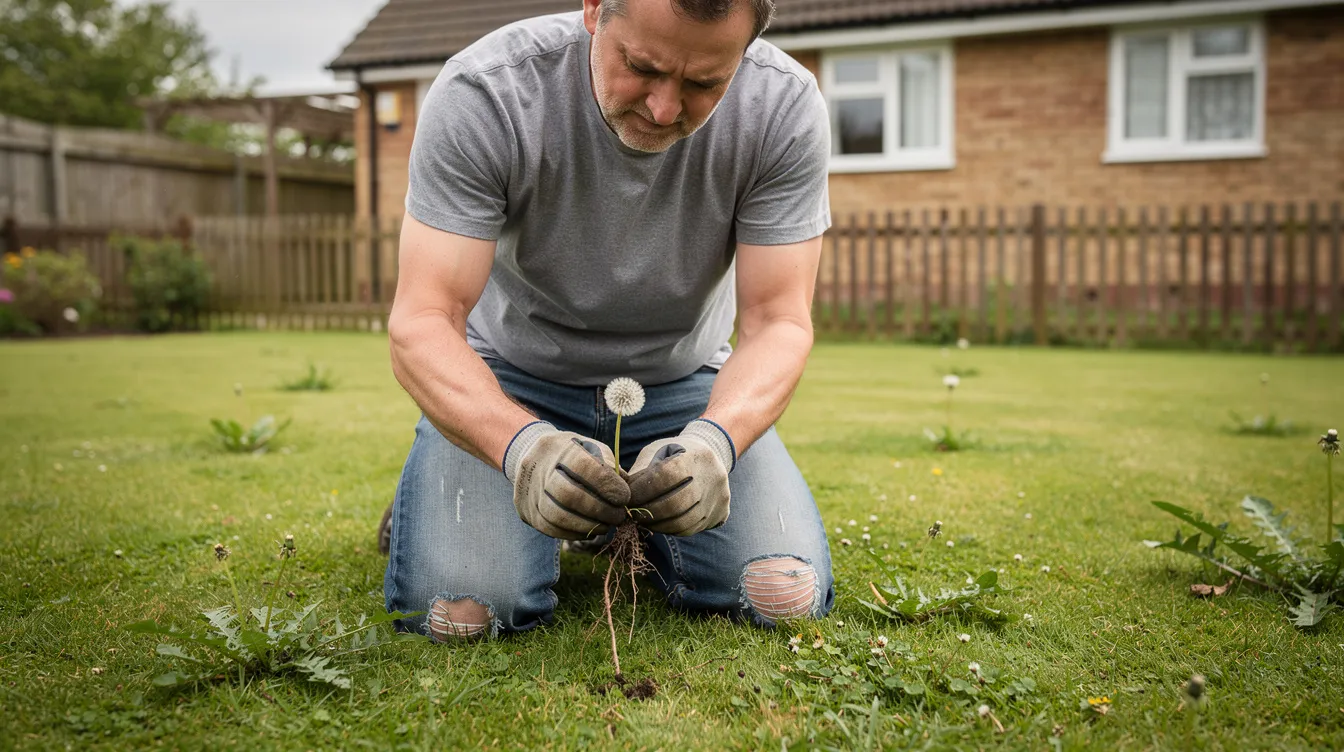
For isolated weeds, especially deep-rooted ones like dandelions, hand removal works well and avoids chemicals entirely. Water the area first to soften the soil, then use a daisy grubber or narrow trowel to lift the whole root system; leave any of it behind and the plant regrows within weeks.
For widespread infestations across a larger area, a selective lawn weedkiller is more realistic than spending a weekend on your knees. Selective products are formulated to kill broadleaf weeds without harming grass, but timing matters: apply when the lawn is actively growing and the soil is moist, not dry, with late spring a good window, and avoid mowing for a few days either side so the product has time to work into the plant. Perennial weeds generally need the whole root gone; surface weeding alone just removes the top growth and the plant regrows from what's left below.
The RHS's general guidance agrees with this order of priority: dense, well-fed, regularly mown turf as the first line of defence, with targeted removal or a selective weedkiller for what gets through. Low mowing can favour some low, creeping weeds, so avoid cutting too short, and keep mower blades sharp so the grass recovers cleanly rather than sitting stressed and open to reinfestation. If you're using a chemical weedkiller, check it's authorised for garden use in the UK.
Why healthy, dense grass is the real long-term fix
A resilient turf is the first line of defence against lawn weeds. Healthy, dense grass outcompetes weeds for light and nutrients, and most weeds only get a foothold in the gaps a thin lawn leaves open: bare patches, compacted ground, or areas that stay damp because drainage is poor. Removing the weeds you can see solves today's problem, not tomorrow's, because as long as those gaps exist, something will move into them.
Different weeds tend to point to different underlying conditions. Creeping buttercup favours persistently damp, poorly drained soil, so improving drainage does more long-term good than repeated hand-weeding. Moss tends to show up in the same damp, shaded conditions that favour weeds, so the two often need the same underlying fix rather than two separate ones. A lawn that's thick enough simply leaves weed seeds nowhere to root in the first place.
That's why weed removal works best paired with overseeding and feeding, rather than as a one-off treatment. If you're pulling the same weeds from the same patch every summer, the patch itself is the thing to fix.
A simple removal and recovery plan
Identify what you're actually dealing with before treating it. A true perennial weed growing from a root system needs the root removed; a low, creeping plant spreading across the surface, like white clover, is more about outcompeting it with denser grass than digging it out plant by plant.
Hand-remove isolated deep-rooted weeds, or apply a selective weedkiller for wider infestations. Once weeds are cleared, overseed any bare patches left behind and feed to support new growth, since thicker turf is what actually stops the same weeds coming back. Rake before mowing to lift low-lying or creeping growth so the mower cuts it rather than skating over the top, and keep the mowing height slightly higher through the recovery period. Grass cut too short lets more light reach bare soil, which is exactly what weed seedlings need to get going, while mowing regularly, rather than letting it go for weeks, knocks weed flowers off before they can set seed and spread further. Keep an eye on lawn edges and nearby beds too; weeds left to seed there just reinfect the lawn a few weeks later.
Weeds are rarely the root problem on a lawn. They're usually the symptom of space grass hasn't filled yet. GREENER's Transformation Kit sequences feeding, seeding and treatment so the lawn fills those gaps itself, instead of leaving room for the next generation of weeds. Not sure whether your lawn needs spot treatment or a full reset? Our free lawn diagnosis quiz will tell you in under two minutes.


