


A hosepipe ban restricts one thing, using a hosepipe connected to the mains, not your ability to look after your lawn altogether. If you're a UK homeowner or gardener dealing with water restrictions, you can still manage hosepipe ban lawn care with a watering can, a water butt, or grey water, and your lawn is built to cope with a dry spell on its own to a point.
Below, you'll find the areas currently affected by hosepipe bans, what watering methods are still allowed, why grass turns brown without necessarily being dead, how to care for your lawn through hot weather without a hosepipe, and the sensible order for bringing it back once restrictions lift. Each section below goes deep in its own dedicated article if you want the full detail.
Which areas currently have hosepipe restrictions or a hosepipe ban
As of mid-July 2026, hosepipe bans are in force or due to start across several parts of the UK:
|
Water company |
Area |
Status |
|---|---|---|
|
South East Water |
Kent |
In force from 3 July, after hosepipe restrictions were announced on 25 June 2026, extending to Sussex, Surrey, Hampshire and Berkshire from 25 July |
|
Southern Water |
Hampshire and Isle of Wight |
In force from 10 July |
|
Anglian Water |
East of England |
In force |
|
Cambridge Water |
Cambridge region |
In force from 9 July |
|
Affinity Water |
Bedfordshire, Berkshire, Buckinghamshire, Hertfordshire, Surrey, parts of London and Essex |
In force |
|
South West Water |
Mid and East Devon |
In force from 14 July |
|
Welsh Water |
West Wales |
Temporary Use Ban in force |
|
United Utilities |
North West |
Due from 5 August |
Bans are added and lifted as reservoir levels change, so treat this table as a snapshot rather than gospel; water restrictions can vary locally, so check local guidelines and your own supplier's website for the current status in your postcode.
They are usually introduced during droughts or low water levels caused by low rainfall and high demand.
In the South East, recent weather left the region with only 36% of normal average rainfall from March to May 2026, while demand for the water supply peaked at 687 million litres on 24 June 2026 as river levels fell.
It's also worth knowing a hosepipe ban isn't the same as a drought order. A hosepipe ban, officially a Temporary Use Ban, is something your water company can impose under the Water Industry Act during serious water shortages, with no fixed end date, and it stays until they judge supplies have recovered, which can mean anywhere from a few weeks to several months. A drought order is a step up from that: it needs government approval, can extend to restricting commercial water use, and is genuinely rare, the last significant ones in the UK were in 2012. If you're only dealing with a hosepipe ban, which is the case almost everywhere right now, the restrictions in this guide are all you need to worry about.
What you're still allowed to do with a watering can
A hosepipe ban bans the method, not all watering: Temporary Use Bans restrict hosepipe use for watering gardens rather than stopping you from watering altogether. You can't connect a hosepipe or sprinkler to the mains supply and point it at the garden, and that includes trigger nozzles, most mains-fed pressure washers, and setups with a pressure reducing valve; a nozzle attachment doesn't get you around the restriction or let you use water wastefully. What you can still use, everywhere, regardless of which company's ban applies to you: a watering can or bucket, water butt rainwater, and grey water from the bath or washing-up bowl for gardens and other plants, with collected rainwater or greywater encouraged where allowed to help save water and cut water usage. Drip irrigation systems deliver water directly to the soil surface and may be worth checking against local rules. There are also common exemptions worth knowing about: newly laid turf is often exempt for up to 28 days after laying where a watering can genuinely isn't practical. We've written out every detail, including what happens if you're caught breaching a ban, in our full breakdown of what's actually allowed.
Why your lawn's gone brown, and why that's not the same as dead
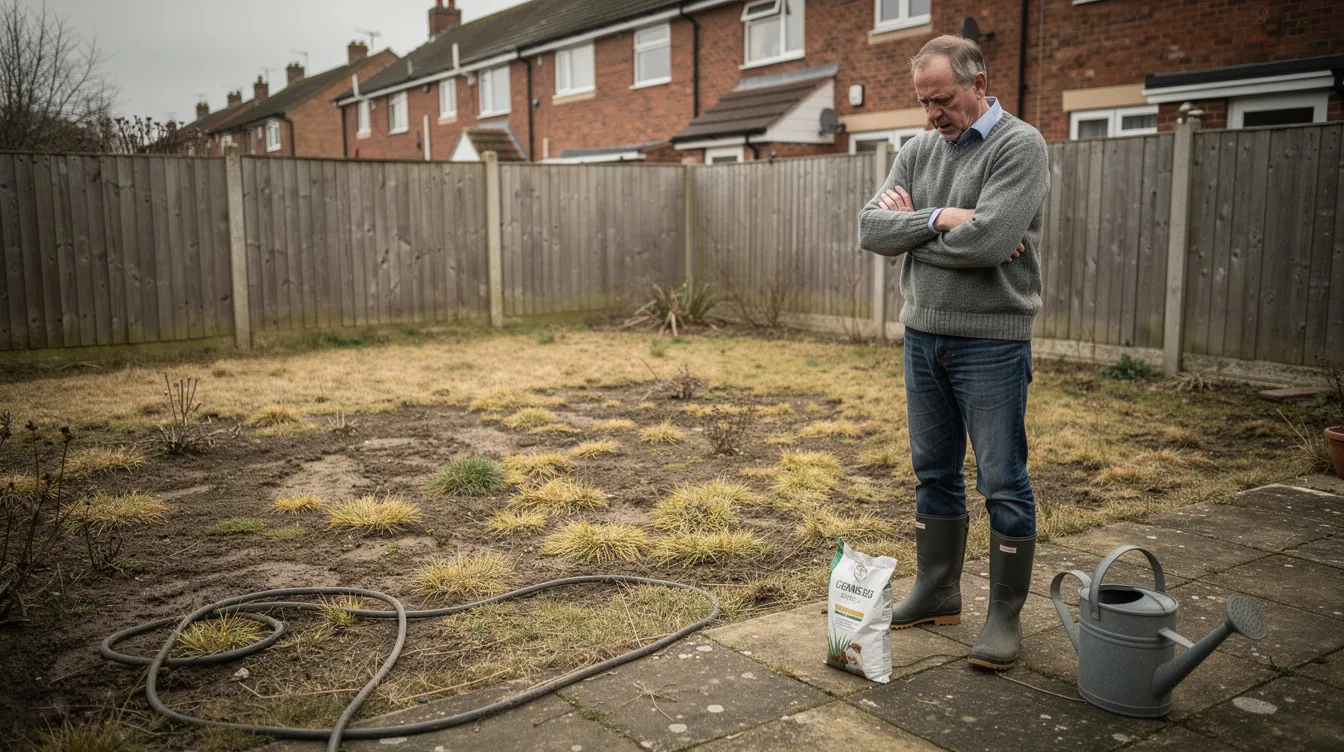
A brown lawn in a drought is very likely dormant, not dying: established grass often turns brown during drought or hot weather because it goes dormant in dry weather, but it usually recovers when rain returns and conditions improve. Grass protects its crown and roots by sacrificing the visible leaf, a deliberate survival strategy, not a collapse. Perennial ryegrass and fescue, the grasses behind most UK lawns, typically survive 6 to 8 weeks of dormancy and green back up within 4 to 6 weeks of rain returning. Two simple checks, tugging a handful of grass to see if it resists, and scratching gently into the soil to look for living white runners, tell you whether a patch is dormant or genuinely gone. We've covered both tests, and exactly when to actually start worrying, in our full piece on why lawns go brown in a drought.
Getting through dry weather and a heatwave without a hosepipe
The best approach during a hosepipe ban or heatwave is to be deliberate rather than trying to keep the whole lawn green. Spend any watering-can effort on new turf, recent repairs, and the most exposed sunny patches early in the morning or late in the evening, outside peak demand times, to reduce evaporation, especially in high temperatures, rather than the whole lawn. Raise your mower's cutting height and mow less often; grass should be mowed at a higher setting during a hosepipe ban, and leaving grass clippings on the lawn helps retain moisture and adds nutrients. Avoid fertilizing lawns during drought, and hold off on any weedkiller or moss treatment entirely, because none of it works on grass that isn't actively growing and it can add stress on top of drought stress. Keep foot traffic down where you can, since excess foot traffic can damage stressed grass during dry conditions. For surrounding planting and nearby green space, native vegetation is a water efficient choice because it reduces the need for watering. The full list of what to prioritise, and what to leave alone entirely, is in our dedicated heatwave care guide.
Bringing your lawn back once it's over
Once rain returns or the ban lifts, resist the urge to throw everything at the lawn straight away. Wait for genuine new growth, not just a change in colour, then mow gently, starting on the highest setting and stepping down gradually rather than scalping it back to normal in one go. Feed only once growth is consistent over a few mows, that's also the point where a proper treatment, like GREENER's Lawn Transformation Kit, is genuinely useful for a fast, visible colour boost, rather than useful as a drought "fix" applied too early. Bare patches that didn't recover need reseeding at the right time of year, which may mean waiting until early autumn rather than rushing seed into ground that's still unpredictable. The full recovery sequence, in the right order, is covered in our dedicated guide to reviving a lawn after drought.
Quick answers
Is a hosepipe ban the same as a drought order?
No. A hosepipe ban (Temporary Use Ban) is imposed directly by your water company and has no fixed end date. A drought order needs government approval, can go further (including restricting some commercial use), and is much rarer, the last significant ones in the UK were in 2012.
How long do hosepipe bans usually last?
There's no set length, they run until the water company judges supplies have recovered enough to lift them. That can mean a few weeks or several months, depending on rainfall.
Will I definitely be fined if I use a hosepipe by accident?
Unlikely for a genuine first-time mistake. The maximum penalty is £1,000 under the Water Industry Act 1991, but in practice, water companies almost always issue a warning first rather than pursuing prosecution straight away.
What are some common prohibited uses during a hosepipe ban?
Typical prohibited uses include using a hosepipe for a paddling pool or domestic swimming in swimming pools, running an ornamental fountain, using sprinkler systems, or cleaning walls at domestic premises. These rules mainly affect non commercial purposes and other domestic recreational use at home, including domestic recreational water features, though some business activity for commercial customers may be exempt, such as a car wash or other commercial customers serving customers at domestic premises.
Do I need to do anything differently if my area moves from a hosepipe ban to a drought order?
Possibly, drought orders can include restrictions beyond garden watering. If your area escalates to a drought order, check your water company's specific guidance rather than assuming the same rules as a standard hosepipe ban still apply.
However long the ban in your area lasts, your lawn isn't something you need to actively rescue day to day. The bulk of the work, and the only part that actually needs care, is getting the sequence right once conditions genuinely improve.
What to do when conditions change
Restrictions differ by water company and exemption, so check the current notice for your area before using a hosepipe. For the practical lawn-care sequence, protect dormant grass during the restriction and avoid aggressive feeding, scarifying or reseeding until moisture and active growth return.
- For the rules question, see whether you can water a lawn during a hosepipe ban.
- For heat protection, use the UK heatwave lawn-care guide.
- After restrictions and drought stress ease, follow the complete drought-recovery plan.


