


The question most UK homeowners reach eventually: is my lawn fixable, or do I need to rip it up and start again?
New turf is expensive, disruptive, and if the underlying soil conditions aren't addressed, often produces the same problems within two years. But genuine renovation requires the lawn to have enough viable grass remaining to recover from.
This guide gives you a clear diagnostic framework: how to assess your lawn honestly, where the threshold between repair and replacement sits, and exactly what renovation involves if your lawn qualifies.
The Honest Threshold: Repair vs Replace
There is a rule of thumb used by professional landscapers that holds up well in practice:
If more than 60–70% of your lawn surface is viable grass, thin, patchy, or mossy but alive renovation is the right approach.
If less than 30–40% is viable grass, or if the underlying soil has serious structural problems, replacement warrants serious consideration.
The 30–70% range in the middle is a judgement call that depends on underlying cause, budget, and tolerance for a longer recovery timeline.
What renovation does: it removes dead organic matter, treats the problems preventing grass from establishing (primarily moss), introduces new seed and the nutrients needed for it to root, and allows the existing viable grass to thicken alongside the new growth.
What renovation cannot do: fix structural soil problems (severe compaction, poor drainage, subsidence), correct a fundamental incompatibility with the site (deep shade, heavily compacted clay), or produce results as quickly as new turf.
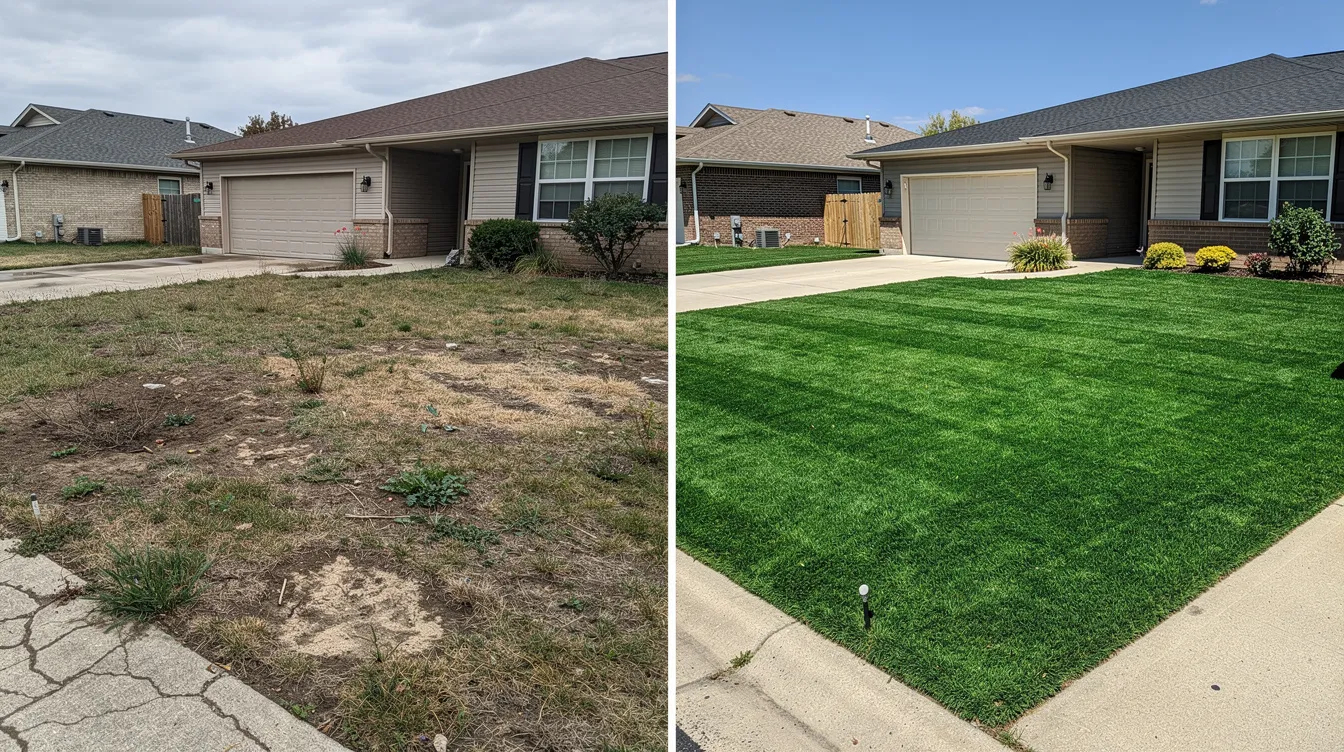
How to Diagnose Your Lawn
Walk the full lawn and assess honestly across four dimensions.
1. What percentage is actually grass?
Get down to ground level in the worst patches and look carefully. Check for bare patches and weeds before judging how much grass is still viable. What appears from a distance to be bare soil often contains sparse grass that is genuinely alive but suppressed by moss or thatch. Conversely, what appears green at a distance is sometimes entirely moss with no grass beneath.
Pull back a handful of the surface material. If you find thin grass blades and soil contact, the grass is recoverable. If you find dense moss mat with no grass root system visible, that area is functionally bare.
Be honest about the percentage. A lawn that is 50% patchy grass and 50% thin-but-alive grass is very different from one that is 50% bare soil.
2. What is causing the damage?
The cause determines whether renovation will work.
Moss the most common cause of damaged UK lawns and highly treatable. Moss can be killed, cleared, and the lawn renovated effectively regardless of coverage. A lawn that is 80% moss with viable grass beneath is a renovation candidate.
Thatch excessive dead organic matter preventing water and nutrients from reaching roots. Fully treatable through scarification.
Compaction soil compacted to the point that roots cannot penetrate. Treatable through hollow-tine aeration, though severe cases may require more extensive soil remediation, especially where waterlogging has weakened grass and created bare patches in the affected areas.
Shade a lawn that receives fewer than 4–5 hours of direct sunlight daily will struggle to maintain dense grass coverage, and shade from trees or structures is a common cause of thin coverage. Renovation can improve it; it won't fully resolve a fundamental light problem. Shade-tolerant seed mixes help but have limits.
Disease fungal diseases (fusarium, red thread) cause specific damage patterns but are generally treatable. Widespread disease without treatment history indicates a chronic issue worth investigating before renovating, much as drought can cause broader lawn damage than a single localised patch.
Chemical damage / contamination localised damaged patches from dog urine, fuel spills, or concentrated fertiliser burn; dog urine often scorches grass and turns it yellow. Usually recoverable through removal of affected soil and reseeding.
Physical damage traffic damage, construction, or vehicle damage, with heavy foot traffic being a common cause of patchy grass areas. Recoverable through scarification, levelling, and renovation.
3. What is the soil condition?
Push a garden fork into multiple areas with moderate pressure. If it penetrates 15cm without significant resistance, soil structure is adequate. If it resists penetration above 10cm, you have soil compaction that needs addressing before renovation.
Cut a cross-section with a spade and examine it. Look for: a brown spongy thatch layer above 1cm (excessive, needs scarification), visible soil structure below (healthy, renovation will work), and waterlogging or standing water in the cut (drainage problem, needs assessment before renovation). Successful repair and overseeding both depend on soil temperature being above 10°C. To improve soil quality, assess overall soil quality before reseeding; on heavy ground, amendments such as compost or finely ground clay can help relieve drainage issues and improve structure.
4. How long has the lawn been in this condition?
A lawn that has deteriorated over two or three seasons is typically more recoverable than one that has been neglected for a decade. Long-term neglect can produce soil biology problems and embedded weed populations that take multiple renovation cycles to address.
When Renovation Is the Right Answer
Renovation is viable and appropriate when:
-
The primary cause is moss, thatch, or compaction (all treatable)
-
There is meaningful viable grass remaining across the lawn
-
The site receives adequate sunlight for grass growth
-
The soil has reasonable structure without severe drainage problems
This describes the majority of UK gardens with problem lawns. In most cases, lawn repair is most cost-effective when thinning areas can be reseeded rather than replaced. In the UK, the best time for this is spring or early autumn. Moss is endemic in the UK's climate. Thatch accumulates in any established lawn without regular scarification. Moderate compaction is standard in any lawn that receives foot traffic.
The perception that a patchy, moss-ridden lawn is "beyond saving" and needs replacing is almost always wrong. It needs proper renovation, which is a different thing, and the route to a perfect lawn is usually gradual rather than instant.
When Replacement Is Worth Considering
Replacement makes sense when:
-
Viable grass coverage is genuinely below 30–40%
-
The underlying cause cannot be treated (severe chronic shade, fundamental drainage failure)
-
The existing turf contains persistent perennial weeds (couch grass, creeping buttercup) that renovation cannot eradicate
-
The soil requires full remediation (contamination, subsidence, complete compaction to depth)
Even in these cases, the correct approach to replacement is soil remediation first, then seeding rather than turfing — if speed matters more than renovation or re turfing, rolled turf is the faster repair option after soil remediation, but new turf laid over unprepared soil produces the same problems.
What Renovation Actually Involves
The correct renovation sequence addresses every treatable cause simultaneously.
Step 1: Kill the moss
Apply a moss killer to the full lawn. Wait 7–14 days for the moss to die back and blacken. This is the step most DIY renovations skip, and it's the primary reason they fail. Any seed applied before moss is cleared cannot make soil contact and will not establish.
Step 2: Scarify
Remove dead moss, thatch, and surface debris through mechanical scarification. Mow slightly shorter first to expose the soil and reach damaged areas more effectively. Run a scarifier in two directions. Rake and remove all debris. Your lawn will look significantly worse — bare soil, sparse grass, exposed surface. This is correct. You're creating the conditions new seed needs, rather than leaving a patchwork quilt of rough, uneven grass.
Aerate compacted areas with a hollow-tine aerator or fork; for lawn health, do this once or twice a year. Remove excess soil from lumps if needed, then top-dress low areas with a thin layer of a sand and sandy loam mix before seeding.
Step 3: Seed bare patches, fertilise, and apply a bio-stimulant simultaneously
High-quality grass seed, a granular fertiliser with mycorrhizal fungi, and a liquid seaweed bio-stimulant applied on the same day. Not sequentially, simultaneously. The best visual match usually comes from using the same grass seed mix as the original lawn, or the closest available match.
The mycorrhizal fungi in a quality fertiliser begin forming a root support network at the moment of germination. They must be present in the soil when germination occurs, not added later. The seaweed bio-stimulant provides natural growth hormones that accelerate germination and improve seedling survival, and pre-germinating lawn seed can improve results in harder-to-establish patches.
This step, simultaneous application of all three, is what separates renovation results that last from those that don't. For bare areas, loosen the soil first, scatter a suitable seed mix or grass seed mix, then lightly rake it in to improve seed-to-soil contact. The fertiliser also supports strong root development in new grass as it establishes.
Step 4: Water and wait
Keep the soil moist for 3–4 weeks with gentle watering so seeds are not washed away. Newly sown grass needs this careful watering until it is established. No foot traffic on seeded areas. First cut at 5–6cm on maximum mower height.
Results are visible in 7–14 days (germination) and meaningful within 4–6 weeks (coverage). Full establishment takes 8–12 weeks.
The Common Mistake That Makes People Think Their Lawn Is Beyond Saving
The majority of UK homeowners who conclude their lawn is "too far gone" to fix have reached that conclusion after one or more failed renovation attempts, typically: seeding without moss treatment, using low-quality annual seed that doesn't persist, or applying fertiliser at the wrong time. Failed repairs also often come down to weak follow-up lawn care, as lawn grasses need regular feeding to maintain health and vigour, so apply lawn feed regularly to maintain grass health.
A lawn that has failed to respond to previous repair attempts is not necessarily beyond renovation. It has failed to respond to an incorrect renovation approach. The correct sequence, with professional-grade products, produces results in lawns that have been written off repeatedly.
Fix Your Lawn with Proper Lawn Repair Before Considering Replacement
The GREENER Transformation Kit is a four-product renovation system, moss treatment, professional grass seed, mycorrhizal fertiliser, and seaweed bio-stimulant, built around the correct application sequence.
If your lawn has tried and failed to recover before, the most likely explanation is sequence, not lawn condition. The kit removes that variable entirely.
Applied in under an hour. Results visible in 4 weeks. Backed by a 60-Day Money Back Guarantee.
Available for lawns from 100m² to 500m². No subscription required.
Frequently Asked Questions
Is my lawn dead or just dormant?
In summer, brown or yellow grass is almost always drought dormancy — the grass has suspended top growth to protect its roots and will recover when rain returns. A genuinely dead lawn detaches easily from the soil when pulled; dormant grass resists. Test several areas before concluding the lawn is dead.
Can I renovate my lawn in stages rather than all at once?
Yes. If the lawn is large or the damage is uneven, treating the worst sections first and extending renovation across subsequent seasons is viable. The same sequence applies to each section, whether you are repairing small patches, reseeding lawn patches, or overseeding bare patches. In UK conditions, overseeding is usually best done in April or September.
How many renovation cycles does a badly neglected lawn need?
Most lawns renovate fully in a single cycle with correct products and sequence. Severely neglected lawns with embedded perennial weeds or heavily depleted soil biology may benefit from two renovation cycles, an initial renovation followed by a second the following autumn after assessing results.
Will the new grass match the existing lawn?
A professional-grade perennial ryegrass mix integrates naturally with most existing UK lawn grass over a full growing season. Exact matching is not achievable, but the visual difference is typically indistinguishable by the following spring.


