


If your lawn has just come through a dry, stressful summer, the best autumn lawn feed for UK conditions is one that's low in nitrogen and higher in potassium and phosphorus, typically an NPK ratio around 4:4:10 or 3:5:12, because autumn feeding is about rebuilding roots and cold tolerance, not pushing soft leaf growth. This is the point where most of the real recovery happens, and using the wrong product at the wrong time is a common way to waste both money and a season's recovery window.
This guide covers why autumn feed needs to do a different job to spring or summer products, how to judge the right NPK balance, when to apply it, whether organic or synthetic feeds make more sense for your lawn, and the practical recovery steps, aeration, scarifying, overseeding, that help the feed actually do its job. BBC Gardeners' World has a useful comparison of autumn feed options if you want to see what's currently recommended.
Why Autumn Feed Is Different
Spring and summer feeds are built around nitrogen, the nutrient that drives visible leaf growth and colour. That's the right priority when the lawn is actively growing through the season and needs to look good.
Autumn is the opposite job. The lawn's growth is slowing as light and temperature drop, so pushing more leaf growth with a high-nitrogen feed is close to counterproductive, particularly on a lawn that's just been through drought stress and needs to rebuild below the surface, not above it. Keeping nitrogen low avoids forcing soft growth right when the plant needs to be putting its energy into roots instead.
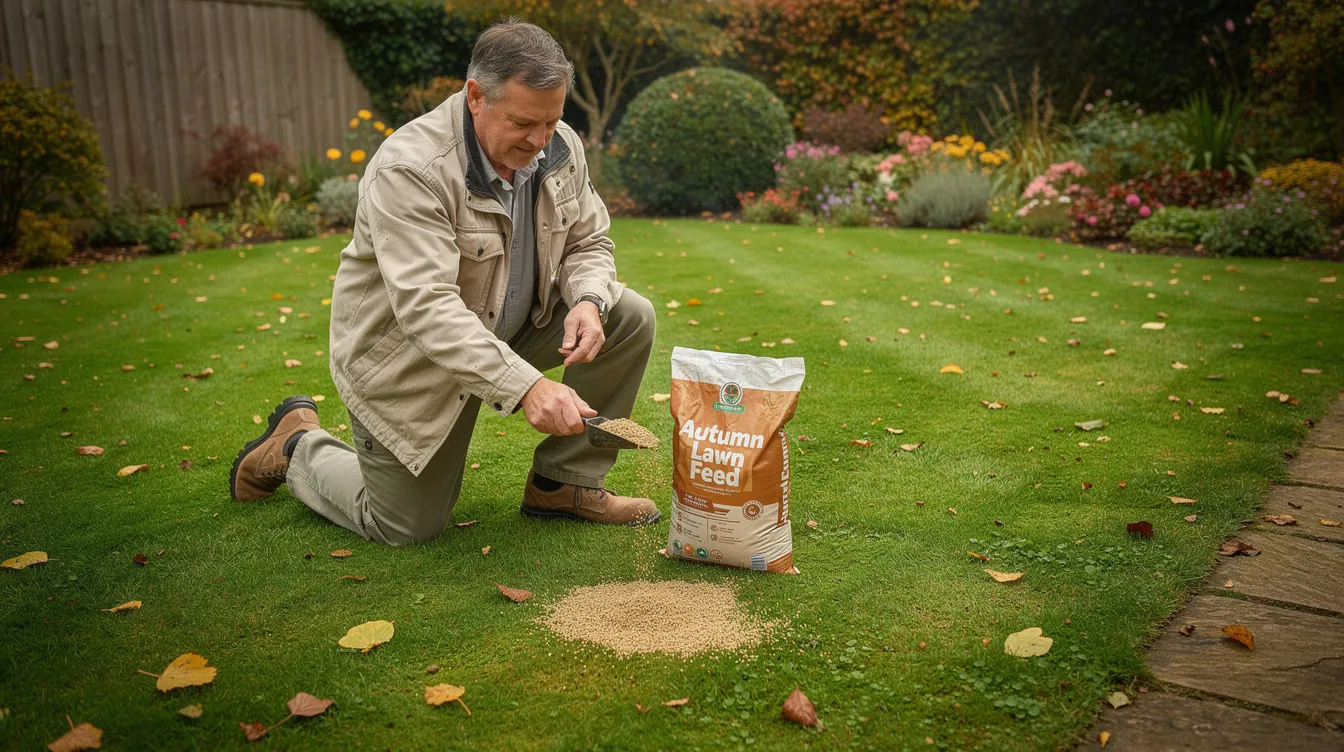
What to Look For: The NPK Ratio
Fertiliser NPK ratios describe the proportion of nitrogen (N), phosphorus (P), and potassium (K). Most lawn care guidance points the same way for autumn use on UK lawns: look for a feed weighted toward potassium and phosphorus rather than nitrogen, ratios in the region of 4:4:10 or 3:5:12 are typical of a properly formulated autumn product.
-
Potassium (K) strengthens root systems and improves the plant's tolerance of cold and future stress, exactly what a drought-recovering lawn needs going into winter.
-
Phosphorus (P) supports root development and establishment, which matters most if you're overseeding at the same time (see our overseeding calendar for timing).
-
Nitrogen (N) is kept low deliberately, enough to support chlorophyll production and maintain colour without forcing leaf growth the plant can't sustain as temperatures drop.
Some autumn products also include iron, which helps suppress moss and keeps the lawn looking green through the darker months.
When to Apply
Start autumn feeding in early autumn, September is usually the most practical time to begin, before soil temperatures fall too far and growth slows to a stop. This lines up closely with the overseeding window, and feeding shortly after overseeding (once seedlings are established) supports the new grass without overwhelming it.
Depending on the product, a single autumn feed can release nutrients over six to eight weeks, meaning one well-timed application in September can carry a lawn through to early winter. Some gardeners apply a second, lighter application in late autumn if growth conditions allow.
Application rates vary a lot between products depending on concentration, so always go by the rate on the label rather than a rough estimate. Over-applying fertiliser can scorch the lawn and, in heavy rain, wash into local watercourses, worth getting right rather than guessing.
Organic vs Synthetic Autumn Feeds
Both have a place, and the choice usually comes down to how hands-off you want the process to be:
Synthetic autumn feeds (like standard granular autumn fertilisers) offer precise, predictable NPK ratios and are straightforward to apply at a known rate.
Organic options, seaweed-based feeds, well-rotted compost, or leafmould brushed into the lawn, add organic matter that improves soil structure over time, which particularly benefits lawns recovering from drought-compacted soil. They tend to release nutrients more slowly and are more forgiving of slightly imprecise application, and some gardeners prefer them across the wider garden for being gentler on the environment.
A combined approach, aeration plus an organic top dressing plus a light synthetic feed, is generally how professional lawn care programmes handle post-drought autumn recovery, since compacted soil limits how well any feed, however good, can actually reach the roots. See our aeration guide if compaction is a concern.
A Simple Autumn Recovery Sequence
-
Confirm the lawn is genuinely recovering, not still dormant (see our drought recovery plan).
-
Aerate if the soil's compacted from summer drought. Most lawns only need this every couple of years in an ordinary year, but a drought like this one is worth treating as the exception rather than waiting for the usual cycle. A garden fork works for small lawns, a mechanical aerator for larger ones.
-
Scarify if thatch has built up or you can't see soil between the grass blades. Easiest straight after a low mow, it clears the thatch and lets water reach the soil properly.
-
Overseed thin areas and reseed bare patches within the September to mid-October window.
-
Apply an autumn feed shortly after, once new seedlings are established.
-
Keep mowing through autumn, around 30mm, to support root recovery.
-
Rake up fallen leaves regularly so they don't smother and yellow the grass underneath.
Why This Is Easier on the Subscription
Getting the ratio right, remembering when autumn actually starts, and switching products four times a year is exactly the kind of thing that's easy to get right once and then forget by the time the next season rolls around. GREENER's seasonal subscription delivers a lawn care box matched to what your lawn actually needs, timed to arrive four times a year: spring, summer, autumn, and winter. The autumn box is built around exactly the ratio described above, potassium and phosphorus led, alongside seed for the same window, so you're never reaching for last season's feed out of habit or guessing at a ratio yourself.
Get every season's feed handled automatically →
FAQs
Can I use a summer lawn feed in autumn if that's what I have left over? It's not recommended. Summer feeds are nitrogen-heavy and push leaf growth the plant can't sustain as light and temperature drop, which can leave the lawn more vulnerable over winter rather than stronger. It's worth using up a summer feed before autumn arrives, or saving it for next spring instead.
How soon after a drought should I start feeding? Only once the lawn shows genuine active growth again, not while it's still dormant or newly out of dormancy. Feeding a stressed, dormant lawn wastes the product and can add further stress, and stressed lawns are also more vulnerable to fungal disease.
Do I need to water in an autumn feed? Light rain shortly after application helps granular feed reach the soil and root zone. UK autumn weather usually provides this naturally, but if conditions stay dry, a light watering (hosepipe restrictions permitting) helps the feed take effect rather than sitting on the surface.
What if my lawn has uneven dips or hollows while I'm doing this work? Shallow dips, up to around 2 to 3cm deep, can usually be filled with a top dressing (roughly 2 to 3kg per square metre) worked into the surface. Deeper hollows take a bit more effort: cut an X-shape into the turf about 5cm deep, fold back the flaps, add fill underneath, then lay the turf back down and firm it in. Levelling the lawn this way makes mowing easier afterwards and helps stop water pooling in the same spots again.


