


"The grass is always greener on the other side" means people tend to see other people's circumstances as better than their own, often unfairly, and it is usually said as a gentle telling-off: stop comparing, what you've got is probably fine, and the thing you're jealous of may be more illusion than reality. It's a warning against envy, but for homeowners and gardeners frustrated by their own patch and eyeing the neighbor's lawn, it also raises a practical question about what can actually be improved.
We built a lawn care brand named directly after that warning. Here, we unpack what the phrase means, where it comes from, how it applies to real lawns, and where the line sits between illusion and achievable lawn improvement. You'll also see why we think it deserves a more useful second reading than "stay put and stop looking," and how GREENER approaches that with a sequenced lawn care method aimed at helping you improve your own grass realistically rather than just envy someone else's.
Where the phrase actually comes from
The idea behind "the grass is always greener" is old, but the exact English wording most people know today took a while to settle. Its origin is often traced to Ovid in 1 B.C., whose Art of Love gives the basic definition through the idea that the harvest looks richer in another man's field. Early figurative uses of "greener grass" as a symbol of somewhere else looking more appealing turn up in American newspapers as far back as the 1850s, though the modern saying belongs to the 19th century. A specific metaphorical version appeared in a Pennsylvania newspaper in 1897, and the phrase in something close to its current form, "the grass always looks a little greener on the other side of the fence," was printed in The Kansas Farmer in February 1917. The saying also comes through a Latin proverb linked to Erasmus and translated into English in 1545 by Richard Taverner, in words about greener hopes and envy.
That detail matters more than it might seem: the phrase didn't start as marketing or poetry, it started as a fairly literal, practical observation about actual grass and actual fences, probably from people who spent their working lives looking at fields. It became a proverb about human psychology afterwards, not the other way round. The publication trail continued into popular culture, and a 1924 American folk song by Raymond B. Egan and Richard A. Whiting, "The Grass Is Always Greener in the Other Fellow's Yard," further spread the fellow's yard image; that song helped make the phrase common from at least the early 1900s, with the other fellow's yard turning envy into a simple picture people still love.
What it usually means, and why that's basically a warning
In its standard use, the idiom means something quite specific: it describes a common human quality, the tendency to idealize other people's situations and imagine their life is better than your own. That impression is usually wrong, or at least exaggerated, because this proverb points to a common cognitive bias: in that context, we often see only the positive side of someone else's circumstances, which can lead to chronic dissatisfaction. The implied advice is to stop comparing and appreciate what you already have. People often assume a different set of circumstances will make them more happy, even though a different set does not automatically mean better. It also reflects a cycle of wanting what we do not have and, in a modern context, FOMO, or fear of missing out.
It's a genuinely useful piece of advice in most contexts. It's also, if you take it completely literally and stop there, a reason to do nothing.
Why we picked a warning as a brand name
Most brand names either describe a product directly (a "Lawn Feed Company") or borrow a vaguely positive word and hope it sticks. We did neither. We took an idiom that specifically tells people their envy is probably misplaced, and built a company around disagreeing with the second half of it.
Here's the actual distinction we're making: the idiom is right that comparison is usually unproductive and the grass "over there" is rarely as perfect as it looks from a distance. Where we think it stops short is the implied conclusion, that because the comparison is usually flawed, you should just stop looking and accept things as they are. For a lawn that's genuinely patchy, thin or moss-covered, that's bad advice. The grass really can be greener, not through comparison or envy, but through an actual, specific, correctly sequenced process. "The grass is always greener" isn't wishful thinking in our name, it's closer to a flat statement of fact about what a properly treated lawn does.
The difference between "greener" as illusion and "greener" as achievable
That's the whole reinterpretation, in one sentence: the idiom uses "greener" to mean an illusion, something that only looks better because you're not close enough to see the flaws, and that illusion of a perfect alternative can stop people appreciating their own lot. We use "greener" to mean a measurable, repeatable outcome, the actual result of clearing what's smothering a lawn, seeding and feeding it properly, and supporting it while it establishes.
That's not a coincidence dressed up as clever brand positioning. It reflects a genuine belief, formed over two decades of professional landscaping experience before GREENER existed as a company, that most people who assume their neighbour's lawn is just "naturally" better are wrong about the cause. It isn't luck, soil type, or a better postcode in most cases. It's usually sequence: someone did the right things in the right order, and someone else didn't, so the better takeaway is to be satisfied with your starting point while still making thoughtful improvements where needed.
Why this idiom lands especially hard for lawns specifically
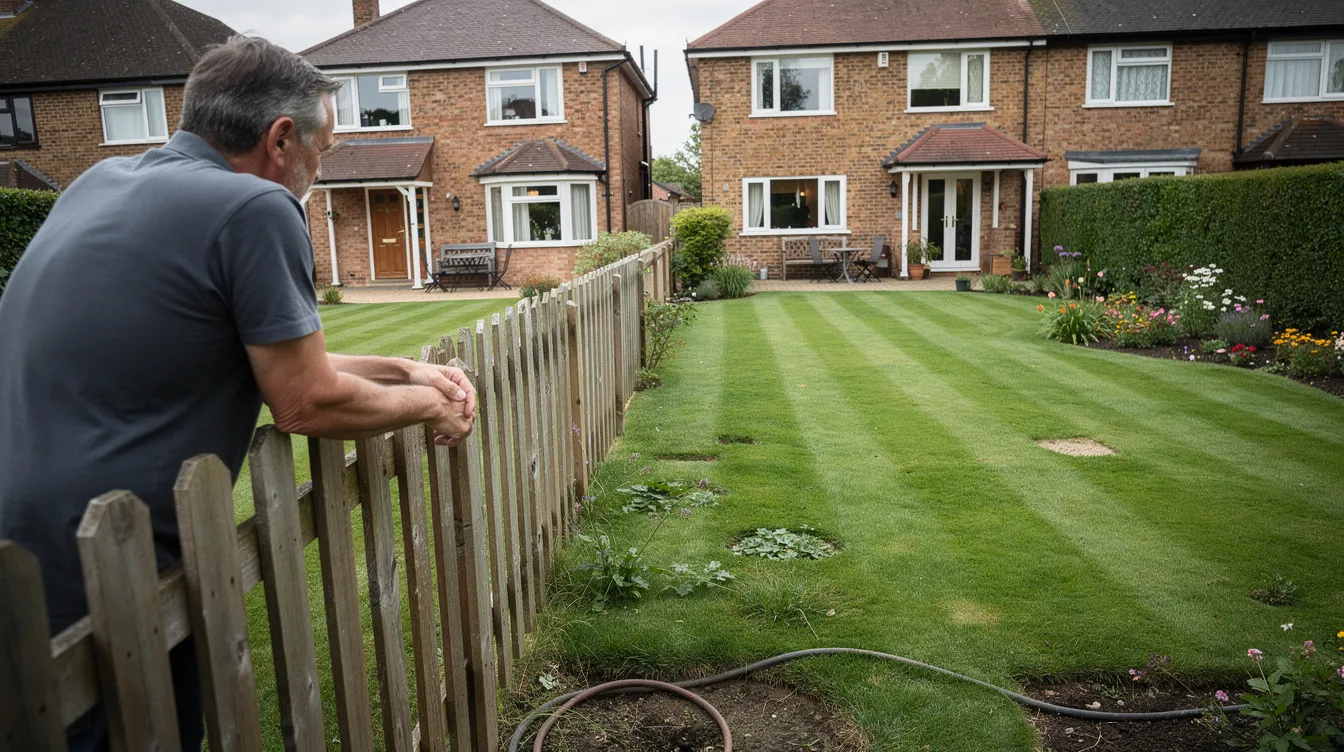
Most idioms get used metaphorically and rarely literally. This one is unusual, because for actual grass, on either side of an actual garden fence, the comparison people are making is completely real and visible every single day. UK gardens, especially the kind of semi-detached and terraced housing with back-to-back or side-by-side gardens common across the country, put neighbouring lawns in direct daily view of each other in a way that most other sources of envy in the idiom (a neighbour's job, a friend's relationship) simply aren't. The same comparison now happens not just over the fence but through social media, which amplifies the sense that other people have better lives. You don't wonder abstractly whether your neighbour's lawn might be greener. You can see it from your kitchen window or across the side of the house.
That's part of why the phrase resonates so specifically for lawn care, more than it would for most other product categories it could theoretically be attached to. The comparison the idiom describes isn't hypothetical here. It's the actual, literal, daily experience that leads a lot of people to make quick judgments from the surface, especially if they've only experienced their own lawn up close, and to search for a way to fix it in the first place.
Where the name meets the method
None of this reinterpretation would mean anything without something behind it. The reason we can turn "the grass is always greener" from a warning into a genuine promise is the same sequenced approach covered elsewhere on this site: clear what's actively working against the lawn first, rebuild with the right seed and nutrition into the space that creates, then support new growth while it establishes, in that order, every time. That's not a slogan, it's the actual mechanism, built from two decades of professional landscaping experience rather than assembled to fit a clever name after the fact.
If you want the fuller story of how that method and this company came together, that's covered in Why We Started GREENER and on our About Us page.
What "the grass is always greener" means on our side of the fence
So here's our actual answer to the question this article is titled after. The idiom is right that envy is usually unproductive and comparison is usually unfair to your own situation. It's wrong, or at least incomplete, when it's read as a reason to stop trying. On your own side of the fence, the grass genuinely can be greener, not because you've convinced yourself to stop noticing the neighbour's lawn, but because you've actually done something about your own.
Ready to find out for yourself? The Lawn Transformation Kit is built specifically to make that true, sized to your garden and backed by the 60-Day Lawn Pledge. Already got the result you wanted and want to hold onto it? Seasonal Care Subscription keeps it that way through the year.
FAQ
What does "the grass is always greener" actually mean?
It means the phrase the grass expresses the common perception that other people's circumstances, including their lawns, are better than their own, reflecting envy and the tendency to idealize others' situations based on a partial or idealised view rather than the full picture. People often believe a different situation will bring greater happiness, which is why the idiom is commonly used as a warning about comparison and a reminder to be content with what you have.
Where does the idiom "the grass is always greener" come from?
Figurative use of "greener grass" to describe somewhere else looking more appealing appears in American newspapers from the 1850s onwards, with a specific metaphorical version recorded in 1897. In one early case, the deeper origin dates back to the Greek poet Ovid in 1 B.C., whose line said harvests seemed richer in another man's field. The phrase in close to its modern wording, "the grass always looks a little greener on the other side of the fence," was published in The Kansas Farmer in February 1917. A related Latin proverb was translated into English in 1545 by Richard Taverner. The familiar modern version was later popularized by a 1924 American folk song about the other fellow's yard.
Is the grass actually greener on the other side?
Sometimes, genuinely, yes, and not always for mysterious reasons. A neighbouring lawn that looks better usually looks better because of something specific and identifiable: less moss, a proper feeding sequence, or grass seed sown at the right time, not luck or an unfair advantage.
Why is GREENER named after a warning against envy?
Because we think the idiom is right about comparison being unproductive but wrong to stop there. If a friend told you the point was not to ignore what you hear next door but to bring that comparison back to your own yard in useful ways, that captures our meaning and gives one of the simplest examples. Rather than telling people to accept a patchy or thin lawn and stop comparing it to next door's, GREENER is built on the belief that the actual gap can be closed with the right method, so the grass really can be greener on your own side.
In short
"The grass is always greener" started as a fairly literal 19th and early 20th century observation about fields and fences, before it became a proverb about human envy and unfair comparison. The traditional advice attached to it is to stop looking and be content. We took the same phrase and built a company on disagreeing with that second part: for an actual lawn, the comparison people are making every day over the fence is real, and it can be closed, not through acceptance, but through the right sequence, applied properly, on your own side.


